One of Europe's leading spring manufacturers, selling into 15 markets — built in 2020 on a custom Svelte headless storefront, years before the rest of the market caught up.

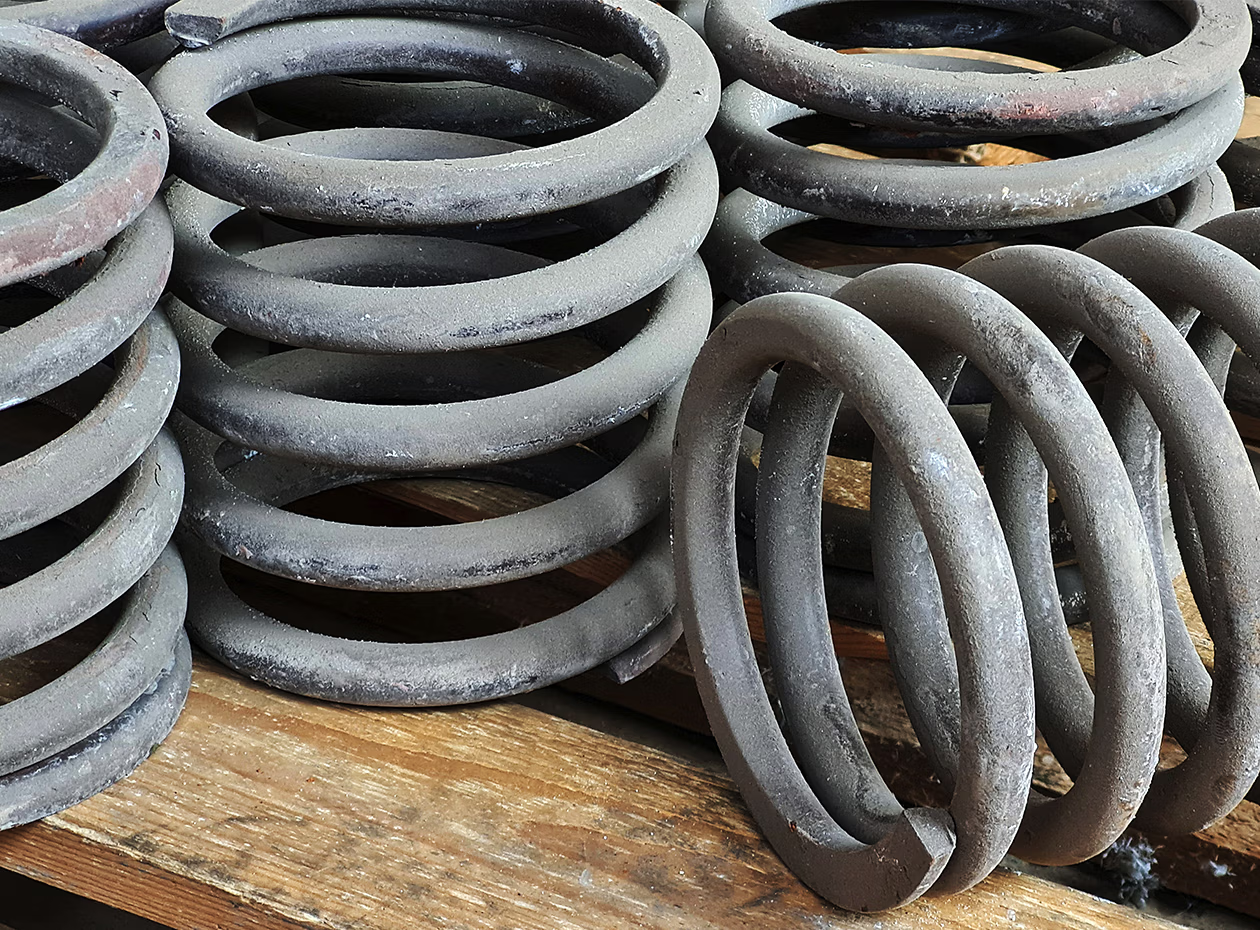
You have touched a Lesjöfors product today without knowing it. Springs sit inside the cars, machines, and devices the world runs on - invisible, precise, essential. Lesjöfors is one of Europe's leading makers of them, with global sales of around SEK 2.5 billion.
A business that precise needs commerce to match. And in 2020, that meant making a bet most agencies were not yet ready to make.
Lesjöfors does not sell to one market. It sells to fifteen - Sweden, Finland, Norway, Denmark, Germany, England, the Netherlands, Latvia, Slovakia, Korea, China, Thailand, Singapore, Mexico, and the USA. Europe, Asia, and the Americas, all at once.
Each market has its own pricing, its own product catalogue, its own marketing rules. And the prices are not static - they move, and they matter. A single wrong figure flowing to the wrong market is a real cost. On top of that, these are technical buyers. They need to find one exact part among thousands, often by working from an exploded-view drawing. Get any of this wrong and you do not just lose a sale. You lose trust with a professional who will not come back.
One store had to behave like fifteen, without becoming fifteen problems to maintain.
Here is what makes this case stand apart. In 2020, "headless" was still a frontier and Svelte was a young, unproven framework. Most builds still meant a monolith and a template. Lybe went the other way - and built Lesjöfors a custom headless storefront in Svelte, on a Progressive Web App standard.
That was an early call, and a deliberate one. A headless architecture freed the customer experience from the constraints of the platform beneath it: faster performance, and the freedom to craft an experience rather than accept a default. Behind that storefront sat Magento 2 as the commerce engine, tightly integrated with the Infor M3 business system so pricing and product data stayed accurate across every one of those fifteen markets.
Choosing the frontier technology early is only smart if it works. This did - and years later, the market moved in exactly the direction that bet had already taken.


The pioneering frontend sat on serious commercial plumbing. A multisite structure carried all fifteen markets on one foundation. B2B functionality handled the hard parts of manufacturing commerce - assortment catalogues, customer-unique pricing, and a customer and user structure built for how professionals actually buy. An exploded-view drawing database let technical customers find the precise component they came for.
None of it started with technology. It started with strategic workshops and a discovery phase to define the objectives, prioritise ruthlessly, and hit the market fast - while laying a foundation for efficiency gains and sales well beyond launch.
There is no gentler way to launch a global store than quietly. Lesjöfors did the opposite. The site went live just before Black Friday - the single most demanding moment in commerce, when traffic spikes and every weakness shows.
It held. Thorough function and load testing meant the launch was not a gamble but a controlled one. The pioneering choice turned out to be the safe choice too.
Lesjöfors got more than a store. It got a foundation built on where commerce was heading, not where it had been - fast, flexible, and ready to grow across markets and years.
The lesson is one every ambitious business eventually meets. The right technology decision, made early, compounds. It is the difference between a platform you replace and one you build on. Lesjöfors made that decision in 2020, on architecture the wider market would only adopt later.
If you're weighing a bold platform decision and want a partner who has made them early and made them work, that is a conversation worth having.